June 12, 2026 · By Denis N.
What 100 Small Business Owners Actually Complain About (And the Operational Waste Underneath)
A while back I started collecting the top-voted posts from three small-business subreddits. I stopped at 100, by which point the same patterns were coming up again and again. Each post got tagged with the operational waste hiding under the surface complaint, the owner's emotional state, and the recurring themes in the comments. Some posts are owners asking for help right now; a good share, especially on r/EntrepreneurRideAlong, are owners looking back at problems they've already been through and writing up what they learned.
What kept coming back, in both kinds of post, was a mismatch: owners working very hard on problems that turned out not to be the real ones, while commenters could often see it from a few paragraphs of text.
The Setup — Where These 100 Posts Came From
I wanted to know what was actually breaking in small businesses — not the version consultants and software vendors describe, but what owners themselves say when they sit down at 11pm and type the question into Reddit.
So I pulled 100 of the top-voted posts from three SMB-focused subreddits: r/smallbusiness (65 posts), r/EntrepreneurRideAlong (26 posts), and r/smallbusinessuk (9 posts). Each post got tagged against four things: the stated problem, the owner's emotional register, the recurring themes in the comment thread, and the TIMWOODS waste categories the underlying operational problem mapped to.
Full disclosure on method: I collected the posts and set the questions; Claude did the reading and the tagging against the framework, and I reviewed the findings and the classifications it produced. Given what this corpus thinks of AI (a finding I'm saving for a separate piece), it seems only fair to say that upfront.
The corpus tilts toward owners who have something to talk about. Pre-revenue and very small businesses are underrepresented because they post less on these subreddits, and the UK slice is small enough (9 posts) that I'm not going to claim anything specific about UK small businesses. Findings below are reported across the full corpus unless the breakdown shifts by community. Where it does, I flag it.
What follows is what owners said vs. what the underlying problem turned out to be, and the gap between those two.
The Headline: Owners Complain About Different Problems Than They Have
Small business owners post about what's on fire, which is reasonable. Nobody opens Reddit at 11pm to write about process design. So the interesting finding isn't that the posts describe symptoms rather than root causes; anyone would. What surprised me was how often the commenters, reading the same few paragraphs the owner wrote, landed on a different problem than the one the owner was asking about.
When you classify each post by the surface complaint, you get more or less the categories any small business survey would produce: cash flow and finances, hiring and team management, marketing and sales, pricing, time management and overwhelm, customer acquisition, strategy and direction. Nothing in that list would surprise anyone who has run a business or read a survey about one.
When you classify the same 100 posts by the operational waste sitting underneath the complaint (what the comments and the embedded details point at), you get a different picture:
- Skills waste appeared in 80 of 100 posts. The owner doing work that someone else should be doing, or the owner missing a knowledge layer they don't know is missing.
- Defects waste appeared in 59 of 100. Process gaps that look fine until they fail: missing scope definitions, undocumented approvals, broken handoff steps that get noticed only after a client ghosts.
- Overproduction waste appeared in 39 of 100. Effort spent on the wrong activity: content production without distribution, lead generation without qualification, feature building without validated demand.
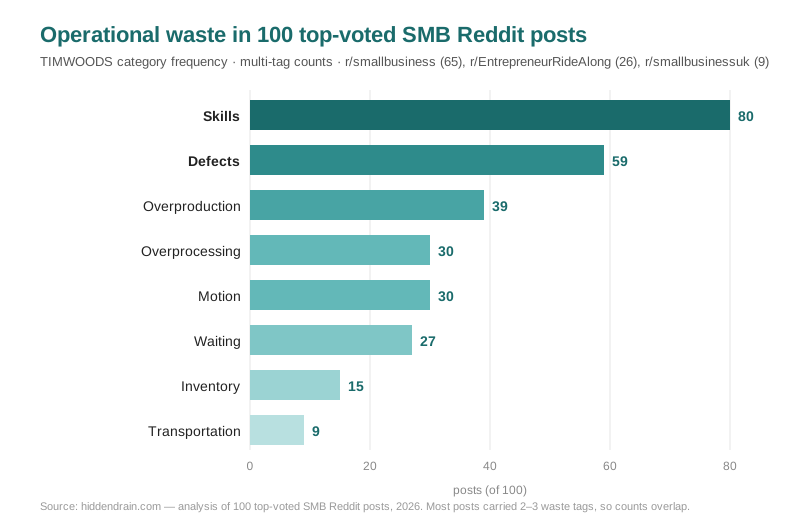
The gap between those two classifications is where this article lives. Owners are working hard on what they think is the problem while commenters keep pointing somewhere else, and in roughly 30 of the 100 posts the top replies go beyond adding advice and effectively re-diagnose the problem as something different from what the owner named. That's about one post in three where a stranger, reading a few paragraphs, saw something the owner standing inside the business couldn't.
A representative example. A 29-year-old COO of a $16M family-owned logistics firm posts that his business is "profitable on paper but cash-flow negative and now behind on rent." He's asking for cash-flow advice. The top comments don't give him cash-flow advice. They tell him the rent jumped from $29k a month to $100k a month, his founder-dad is mixing personal expenses with the business accounts, and the company has no CFO. None of those are cash-flow problems. They map to Skills (no CFO), Waiting (decisions stall at the founder), and Overprocessing (with personal and business spending tangled together, every financial question takes extra work to untangle before anyone can answer it), and all of them were wearing a cash-flow disguise.
That pattern, where the owner sees cash flow and the comments see deeper problems in how the business runs, repeats across the corpus in different forms. The next four sections work through the most common ones.
What 80 of 100 Posts Have in Common: Skills Waste
The single most common operational pattern in the corpus is one most owners have never heard named. Skills waste, the systematic underuse of human capability, appeared in 80 of the 100 posts. You probably know it by its everyday symptoms: "I'll just do it myself," "everything goes through me," "I hired people to do the work but I still end up doing it."
In this corpus, Skills waste shows up in three repeating shapes.
The first is the owner doing work below their level. A solo HVAC owner described handling sales, bids, client calls, ordering, "and sometimes even stepping in as a tech because my 1099 contractors are busy with other jobs." He was working 12 to 18 hours a day and asking Reddit where to find a partner. A 3D-printing shop owner was personally printing, post-processing, packaging, and shipping every order, leaving zero hours for anything that might grow the business. A SaaS founder put it cleanly: "The product isn't the bottleneck. I am. Every hour I spend on admin is an hour I'm not spending on the things that actually move the company forward."
Naming this as Skills waste matters because it changes what the fix looks like. If the problem is "I'm overwhelmed," the fix looks like working harder or finding a co-founder. If the problem is "the most expensive person in the company is doing $15-an-hour work," the fix is a list: write down everything you did last week, mark what someone else could do with a one-page instruction, and hand off the bottom of the list first. The commenters in these threads give versions of that advice over and over; one called it firing yourself from the bottom up. The bottleneck self-diagnostic walks through the same move in more detail.
The second shape is a missing knowledge layer the owner doesn't know is missing. The logistics COO from the opening example has a CFO-shaped hole in his company and frames it as an efficiency problem. A UK owner asks Reddit whether home-office air conditioning is deductible instead of having an accountant relationship. An owner asks how to terminate a chronically absent employee, and the comments reveal there's no documentation, no return-to-work form, no performance plan: the missing layer is HR knowledge, and the owner discovered it at the worst possible moment.
The third shape is credibility the owner already has but isn't using. A fractional CFO sent 1,000 cold emails and landed zero clients. A video-editing agency with testimonials from channels with millions of subscribers had zero retainer clients. The strongest asset in both cases is the track record: the CFO's credentials, the agency's named results. Both owners had it sitting in a drawer while they ran volume cold outreach, which is the one channel where a track record does nothing, because strangers skimming an unsolicited email have no reason to believe it.
That third shape loops back to the first. Owners who do everything themselves eventually try to hire their way out, and many go looking for an employee with "my work ethic." One commenter closed that loop in a single line: "If they could do everything, they would have their own business." The way out isn't finding a smaller copy of yourself; it's splitting the work so that normal, competent people can each take a defined piece of it.
For what it's worth, this finding doesn't depend on which community you look at: Skills waste appeared in 83% of r/smallbusiness posts, 77% on r/EntrepreneurRideAlong, and 67% on r/smallbusinessuk. Three subreddits with noticeably different cultures, and the same pattern sits on top in all of them.
The Second Layer: Defects in 59 of 100 Posts
The second most common pattern is process gaps that look fine until they fail. In lean language this is Defects waste, and it appeared in 59 of the 100 posts. Not defective products, defective processes: the missing scope definition, the undocumented approval, the handoff step nobody owns.
The cleanest example in the corpus is a consultant who audited 18 months of a client's CRM looking for the leak in their sales process. He found it: 2,045 leads had received the automated welcome email, and zero had received a personal follow-up. The close rate without a human reply was 1.08%. With one, it was 20.29%, on the same offer with the same team. The automated email made everyone assume the funnel was working, and the conversion-driving step was nobody's documented job. The leak sat in the CRM for years because the process looked done.
A web developer delivered a $2,500 restaurant site, then absorbed 12 hours of unbilled "quick questions." When he started charging for extra work, the client left a 1-star review accusing him of hidden fees. The defect here wasn't an unreasonable client. Nothing in the project ever defined where "done" ended and "extra" began, so the client believed he was asking for things he had already paid for.
And a metal-fab shop owner ran the most honest process test in the corpus: he went off-grid for five days to see if his business could run without him. It couldn't make it past day three. His diagnosis: "Turns out I am the process for about half the things that happen in my shop. Not because my team is bad but because I never wrote anything down."
Quality professionals have a number for this category. The American Society for Quality's 2025 Cost of Quality research puts the total cost of poor quality at 15–20% of sales revenue in a typical business, and found that only about a third of business leaders fully understand what these failures cost them. That tracks with the corpus: most of the cost traces back to gaps like the ones above rather than to anyone doing bad work, which is why it never shows up as a line item. Defects waste is also the most stable finding across the three communities (58%, 58%, and 67%), and the category owners are least likely to see coming, because a missing process step generates no signal until the day it costs you a client. That is why the same businesses keep having the same emergencies, the pattern behind chronic firefighting.
Overproduction: The Finding That Depends on Which Subreddit You Ask
The third-place finding comes with an asterisk. Overproduction waste (effort spent producing the wrong thing) appeared in 39 of 100 posts, but the distribution is uneven in an interesting way: 65% of r/EntrepreneurRideAlong posts showed Overproduction patterns versus 32% of r/smallbusiness and just 11% of r/smallbusinessuk.
That gap is probably not noise, because the communities host different conversations: r/EntrepreneurRideAlong is where people post about building businesses, r/smallbusiness is mostly people running them, and over-effort on the wrong activity is the natural failure mode of the building stage. A founder nine months into an "AI co-founder" tool: people say they like it, nobody uses it. Another spent three days "refactoring my database structure for an app that currently has exactly zero paid users." A third confessed the corpus's best one-liner on the subject: "I confused traffic with demand. 40K uniques feels huge at 2am."
In the running-a-business communities, Overproduction looks different: leads generated faster than anyone follows them up, inventory bought faster than the channel can move it, polished social content produced for an algorithm that wanted consistency instead.
The takeaway is that Overproduction is a stage signal. If you're building, your most likely operational waste is making more of something (features, content, leads) than your validation or conversion can absorb. If you're running, the hard work is usually real but pointed at maintenance instead of progress. One owner in the corpus drew the distinction perfectly: "I thought I was busy. Turns out I was just active. There's a difference."
The Owner-Misdiagnosis Pattern
One more pattern deserves its own section, because it's the one I'd most want an owner to take away from this article. In roughly 30 of the 100 posts, the owner names one problem and the comment thread re-diagnoses it as another, and the re-diagnosis follows a consistent direction: owners tend to name a surface (an employee, a tool, a market), while commenters tend to name a structure (a process, a permission, a scope).
Here are four of the clearest cases.
A healthcare-clinic owner says he's "held hostage by a high performer" — a star receptionist resisting every workflow change. He frames it as an employee problem. The 280-comment thread frames it as a change-management problem: the person most affected by the changes was never involved in designing them.
A B2B services founder asks how revenue keeps going up while the bank account stays empty. He frames it as a cash-flow problem. The comments frame it as a terms problem: $180,000 sat in unpaid invoices because bigger customers came with longer payment terms and no deposit policy.
A local business owner asks whether $3,500 a month for SEO is fair pricing. The comments don't answer the pricing question. They tell him he doesn't need an agency at all: Google Business Profile and reviews would cover a local trade.
And the burnt-out HVAC owner asking where to find a partner gets the corpus's sharpest reframe: "You don't have a people problem. You have an infrastructure problem."
Lay the four next to each other and the direction is hard to miss. An employee problem, a money problem, a vendor problem, and a people problem got re-diagnosed as change management, payment terms, channel fit, and missing systems. In each case the owner's version pointed at something outside the business, and the community's version pointed at a process inside it, one the owner actually controls. The community's version is less comfortable to hear, but it's the one that can be fixed without waiting for an employee, a client, or a market to change first.
The Manual Follow-Up Pain: 22 Posts, One Pattern
The most repeated specific pain in the corpus, appearing in 22 of the 100 posts, is manual follow-up: chasing invoices, chasing leads, chasing employees about tasks, pushing out social posts, sending client updates. Whatever is being chased, the underlying situation is the same one: the follow-up only happens if the owner personally does it.
The invoice version dominates. A freelancer dreads sending payment reminders because it feels awkward and unprofessional; the top comment dismantles the dread in one move: "The awkward already happened. It just happened on their end when they didn't pay." A wellness clinic owner is at her wits' end with one chronic late payer who has effectively trained her to be his accounts-receivable department. A vendor watching payment promises evaporate gets the corpus's bluntest line: "Once you realize you're a bank, you'll get an understanding."
The cost of this kind of work is easy to underestimate because each individual chase takes a few minutes, and no single instance ever justifies building a system around it. Added up across clients, weeks, and channels, those few-minute tasks become a standing part of the owner's working day, and the cash side compounds the time side: the Federal Reserve's 2025 Report on Employer Firms found that among small firms seeking financing, 56% did so to cover operating expenses rather than to grow. For a services business, some part of that gap is money already earned, sitting in unpaid invoices and waiting for someone to chase it. The arithmetic of what those recurring hours cost over a year is worth running for your own business.
What This Means If You're Running One of These Businesses
Here's the compressed version of 100 posts. If you can't put a name on your operational problem, if all you have is "I'm overwhelmed," "marketing isn't working," or "I can't find good people," the corpus says the most likely candidates are Skills waste (80% of posts) and Defects waste (59%). You doing work someone else should do, or a process gap that looks fine until it fails. Usually both, because they feed each other: nothing is written down, so everything routes through you, so nothing gets written down.
The pattern that should give you the most hope is the misdiagnosis one. The owners in those 30 posts weren't failing at effort. They were pointed at the wrong target, and a stranger in the comments could see it because the stranger wasn't standing inside the business.
There's a low-tech way to borrow that outside view tonight. Write down the two or three problems you'd post to Reddit about if you were going to. Then, for each one, ask what a commenter who could see your books and your inbox would say is behind it. If the honest answer involves work you shouldn't personally be doing, or a step that exists only in your head, you've found your Skills or Defects waste, and either one gives you a concrete place to start: a handoff to write down, or a process step to put in writing before it fails again.
Methodology Notes and Limitations
The corpus is 100 top-voted posts: r/smallbusiness (65), r/EntrepreneurRideAlong (26), r/smallbusinessuk (9). Each post was tagged against the eight TIMWOODS categories, the stated problem, the owner's emotional register, and the comment-thread themes. Most posts carried two or three waste tags, so category counts overlap. Not every post is a help request: roughly half the r/EntrepreneurRideAlong slice are lesson posts where the owner describes problems already survived, and the tags capture the problems they describe. And 14 posts mapped mostly to "Other" because the dominant cause was external (tariffs, a lost lease) or the founder's own health rather than an operational pattern; no waste framework has much to say about those, and I haven't pretended otherwise.
A method like this comes with limits worth spelling out. Reddit posters self-select: the corpus over-represents owners articulate enough to write a post that gets upvoted, and under-represents pre-revenue businesses and anyone not on Reddit. The UK slice (9 posts) is too small for any UK-specific claim, so I haven't made one. Quotes are lightly anonymised: no usernames, no business names, no locations. And these counts describe how often problems show up in posts that surface, not how often they occur across all small businesses. Read them as a strong directional signal, not a census.
Get the Outside View the Comment Section Gave These Owners
The owners in these 100 posts shared one blind spot: it's hard to diagnose a process you're standing in the middle of. HiddenDrain plays the role the comment thread played here. It maps your answers to the same TIMWOODS categories used in this analysis and points at the waste pattern you're most likely misnaming, the way the commenters did for the COO who thought he had a cash-flow problem. Six to eight questions, free, in under 10 minutes. No signup required.
Written by Denis N. — process improvement specialist based in Yerevan, Armenia. PMP and ACP certified. Eight years applying lean methodology across service teams in IT, retail, and banking.